



Google Ads copy with AI: fix the ad group first, then check the combinations
by Kunal MahajanBetter ads start with the right searches and the facts on your product page.
Say you run an online cycling store. Someone searches for a commuter bike pannier and your ad comes up: “Waterproof Commuter Bag. Fits Every Bike!” They click. The product page then tells them the bag is water-resistant and fits certain rear racks.
The ad promised both. The page confirms neither. You paid for a click from someone who now doubts the offer.
It’s tempting to blame the AI’s writing. But AI was never given clear limits on what it could claim. Nobody decided which searches this ad was meant to answer, which page would back it up, or which facts the AI was allowed to turn into claims. This post works through those decisions using a made-up, purpose-led cycling store, then looks at what happens once Google starts mixing your headlines together.
Start with what the shopper searched
Our store sells cargo bikes, bike trailers and commuter panniers. “Cargo bike for two kids,” “bike trailer for two kids” and “commuter bike pannier” could all sit under one broad cycling theme, yet they are three different purchases. An ad that says “Bike Gear for Every Ride” can show for all of them and gives none of those shoppers a reason to pick this store.
So take the pannier shopper for a ride. They want a bag for commuting, and they’ll judge it on capacity, rack fit and weather protection. Searches belong in the same ad group when one product page, or one relevant collection page, can answer them with one clear offer. Cargo bikes and trailers get their own messages and their own destinations.
You don’t need a new ad group for every word order, though. Group searches by buying intent. You don’t need a separate ad group for every word order. “Rear bike pannier for commuting” and “commuter rear pannier” describe the same buying intent, and Google’s phrase and exact match guidance already covers searches with similar meaning or intent. A sensible phrase match keyword will pick up the close variants. Exact match is still worth using where you want tighter control or separate reporting. Either way, read the actual search terms, because match types don’t guarantee that every variation stays on topic.
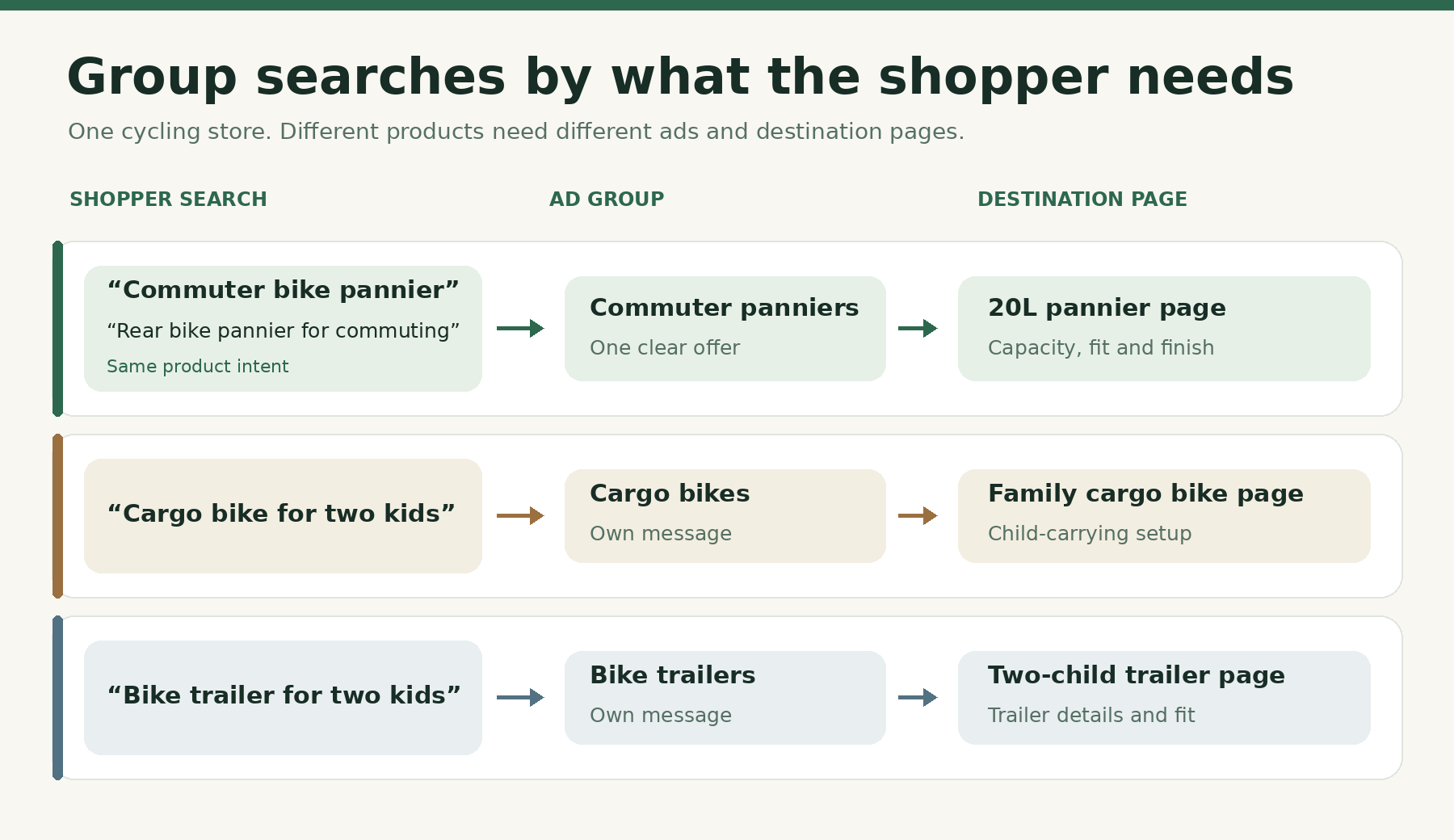
Google’s tools will show you where a theme starts. Where it ends is your call. Search Terms Insights groups the searches that triggered your ads, and Keyword Planner suggests ways to organise new keywords. If a “family cycling” theme includes a complete cargo bike, a trailer and a child seat, Google is telling you those things are related. That’s true, but it still doesn’t necessarily mean one ad and one landing page will work for all three buyers.
With products and pages sorted, the major factors to look at are volume, bids, seasonality and what a sale is worth to you. An expensive click from someone ready to buy a cargo bike can be well worth it. A cheap click from someone looking for a local rental is wasted on a store that only ships new bikes. CPC matters, but a cheap click is still wasted if the shopper wants something you don’t sell. Neither can Keyword Planner’s competition figure, which only measures competition among advertisers.
Let the product page set the limits
The pannier group now has a clear job. Before asking AI for anything outside the box, check what’s inside Check what the product page can honestly promise.
In our example, the pannier holds 20 litres, has a water-resistant finish and fits a specified range of rear racks. (for illustration) “20L Commuter Bike Pannier” is useful and true. “Waterproof in Any Weather” and “Fits Every Bike” both say more than the page does.
This check matters more when a store sells several related products, because a line that looks harmless in a spreadsheet can send someone to the wrong item.
| What the shopper searched | What the page needs to confirm | A line we would reject | Better direction |
| “Cargo bike for two kids” | The bike’s child-carrying setup and compatibility | “Bike Trailers for Two Kids” | Name the cargo bike and invite the shopper to check its setup. |
| “Commuter bike pannier” | Capacity, rack fit and weather-protection wording | “Fits Every Bike” | Name the pannier and point to its rack-fit information. |
| “Recycled-material bike bag” | A material claim for that specific bag | “Every Bag Is Recycled” | State the supported claim only for the bag it applies to. |
These are three different mistakes. The first shopper could end up looking at the wrong kind of product, the second finds out about a fit problem only after clicking, and the third discovers the material claim belongs to another bag. All three happen for the same reason: the copy was written without enough product context.
A Certified B Corp store has one more focus. B Lab is clear that certification applies to the company and not to individual products, so it says nothing about a particular bag’s fabric, waterproof rating or carbon footprint. If one bag does have a verified recycled-material claim, pin down which material, which product, and where on the page the claim is supported before it goes anywhere near an ad.
The shopper’s wording also tells you which fact to lead with. Someone typing “20L bike pannier” probably cares most about capacity and fit. Someone typing “recycled-material bike bag” asked about material, so a supported material detail can go first, as long as the ad still says what the bag is for. We apply the same thinking to the page itself in our guide to sustainable product descriptions.
Find your angle before asking AI for headlines
Knowing what you’re allowed to say is half part of the story. The ad also has to stand out from the others on the results page, so catchiness is of the essence. Search the term in the market you serve and note what competitors are running and when you saw it. If every ad promises “durable bike bags” and your store has a properly useful rack compatibility guide, the guide may be the stronger reason to click. A competitor’s website helps you understand their positioning, but it doesn’t prove which ad showed for a query, and it can’t back up your own claims.
Now the AI brief can be specific. Give it the search theme, the landing page, the relevant product specs, the offers you can support, delivery and warranty terms, the markets you serve, your brand voice and the claims it must avoid. Add what you saw in competitor ads and what you want the shopper to come away understanding. You can ask the AI to read your wider website for context, but check which pages it opened and paste in anything important it missed.
For the pannier group, part of the brief might read:
“These searches are for a commuter pannier, not a cargo bike or trailer. The page describes a 20-litre bag with a water-resistant finish and lists compatible rear racks. Use those facts. Do not call it waterproof or say it fits every bike.”
The full brief would also ask for distinct headline angles and a review of how the assets work together. That is far more reliable than pasting in every keyword in the account and hoping the AI works out the offer for itself.
Ask for a few directions before you ask for a finished copy. One might lead with capacity, another with rack compatibility, and a third with a verified material detail if this bag has one. Choose the direction that suits the search and the page, then have the AI develop headlines and descriptions from it. Google’s conversational ad creation experience can generate ideas too, where it’s available. Whichever tool you use, the decisions about product and claims stay with you.
Check what happens when Google puts the lines together
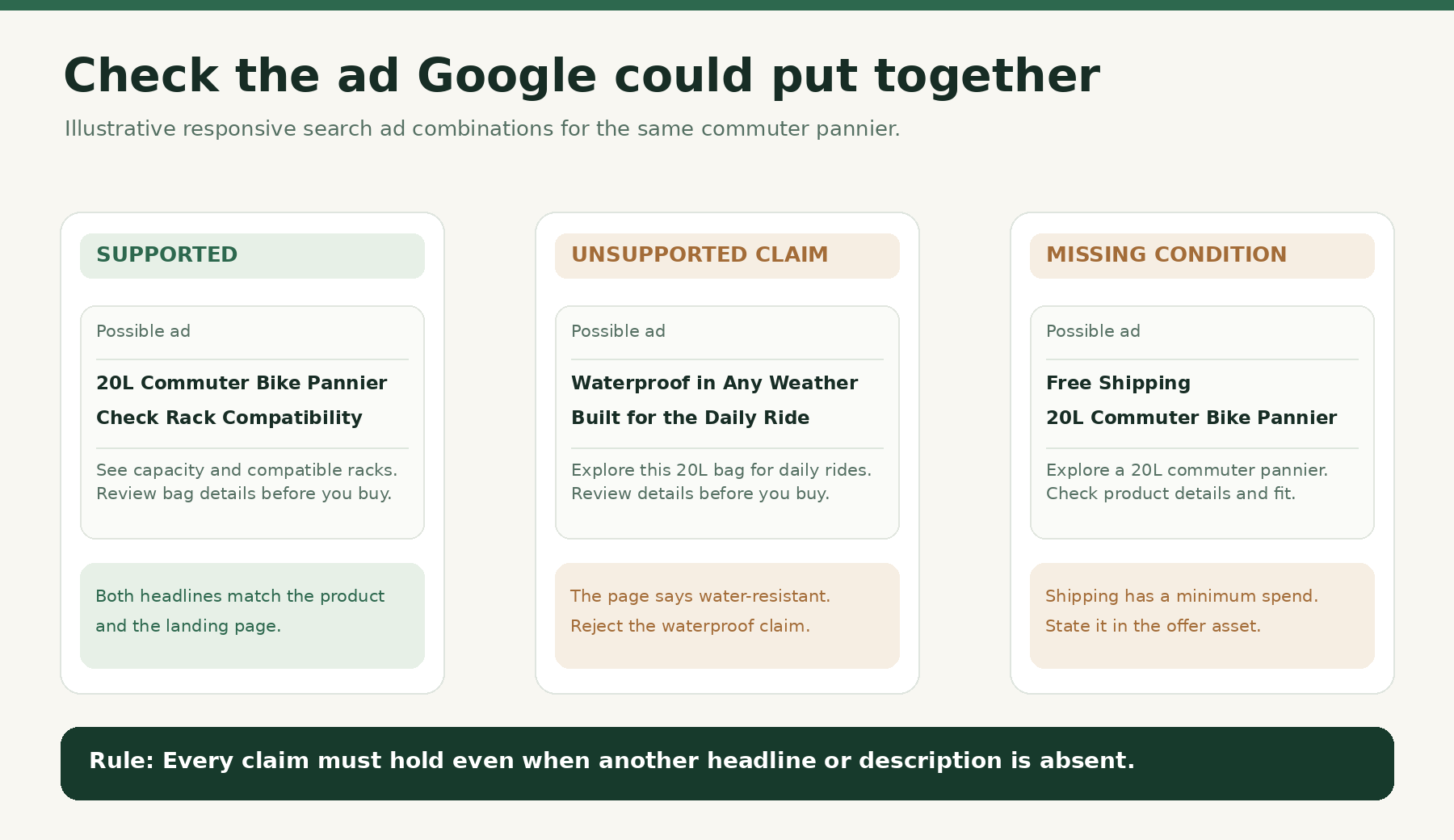
The AI will probably hand back a list of lines that each look fine. The trouble is that shoppers won’t necessarily see them in the order you wrote them. In a responsive search ad you supply the headlines and descriptions, Google assembles them in different orders, and some assets may never show. So the permutation and combination needs to make sense in every case (unless you are simply using the brand pinned strategy).
Take three pannier headlines. “20L Commuter Bike Pannier” says what the product is. “Check Rack Compatibility” speaks to a likely hesitation. “Built for the Daily Ride” gives the ad some character. Each does a different job, and none of them needs to repeat “commuter pannier.” Compare that with “Discover Unmatched Cycling Excellence,” which sounds like an ad and tells the buyer almost nothing.
Now suppose the AI also offers “Waterproof in Any Weather.” You can’t fix that headline by putting an accurate description somewhere else, because the description might not appear. “Free Shipping” has the same problem if the offer needs a minimum spend that is only mentioned in another optional line. Either put the condition in the same asset as the promise or rewrite the promise.
The other products need their own checks. “Carry Two Kids” belongs only with a cargo bike whose setup supports it, never in a trailer or pannier ad. A recycled-material headline belongs with the one bag that has the evidence, and the retailer’s B Corp status doesn’t extend it to the rest of the range. Review the combinations against the offer each ad group is supposed to make, and preview the ad before publishing.
Dynamic keyword insertion deserves the same suspicion. If a rear pannier ad can also be triggered by an eligible “handlebar bike bag” keyword, keyword insertion may drop that keyword into the headline and advertise the wrong mounting position. Keep in mind that what gets inserted is the keyword from your account that matched, which isn’t necessarily what the shopper typed, and the feature has no effect on matching itself. Go through every eligible keyword, check the fallback text, and read each inserted phrase in place. Often a plain written headline like “Shop Rear Bike Panniers” is the safer and clearer choice.
Pinning helps when a brand headline or another essential message has to appear in a particular position. It also cuts down the combinations Google can try, so weigh that up. And a pinned brand name won’t rescue an inaccurate “Fits Every Bike.” It’s an easier strategy though and one of the three RSAs can do this for most businesses as Brand name shows credibility.
Ad Strength will flag thin or repetitive assets, and a Good or Excellent rating is useful feedback if you can get there with truthful copy. Google says the rating isn’t used to calculate Ad Rank, Quality Score or auction wins, so don’t chase it at the expense of accuracy. Whether shoppers understand the ad and whether it makes you money are separate questions you have to check yourself.
This is why we think filling fifteen headline slots is the least interesting thing AI can do here. It’s better used to explore angles and catch clashes between lines, while you decide which combinations are both true and worth clicking.
What earlier client work taught us
None of this started with generative AI. Our published case study on Perennial Cycle, a retailer of bikes and trikes, describes matching the right products to the right search queries at a workable CPC, organising categories and brands, and excluding traffic that didn’t convert. Comparing January with June 2020, the case study reports a 25% lower CPC and 616.91% higher revenue for the Shopping channel.
To be clear about what that shows: it was a Shopping campaign run with the methods available at the time. It doesn’t measure AI-written responsive search ads, and no headline can take credit for those numbers. What it does show is how much rides on the first decision in this post, which is knowing what the shopper wants and which product can meet it. That same judgment now goes into the brief we give AI before it suggests any Search copy.
Follow the click back to the promise
Once a new ad is live, find out whether its message brought in the right shopper. For the commuter pannier, check which searches triggered the ad and what people did on the page. Did they find the rack information? Did the shopper who cares about materials land on the bag with the supported claim? If cargo bike searches are arriving at a pannier page, look at the targeting or the group structure before touching the copy.
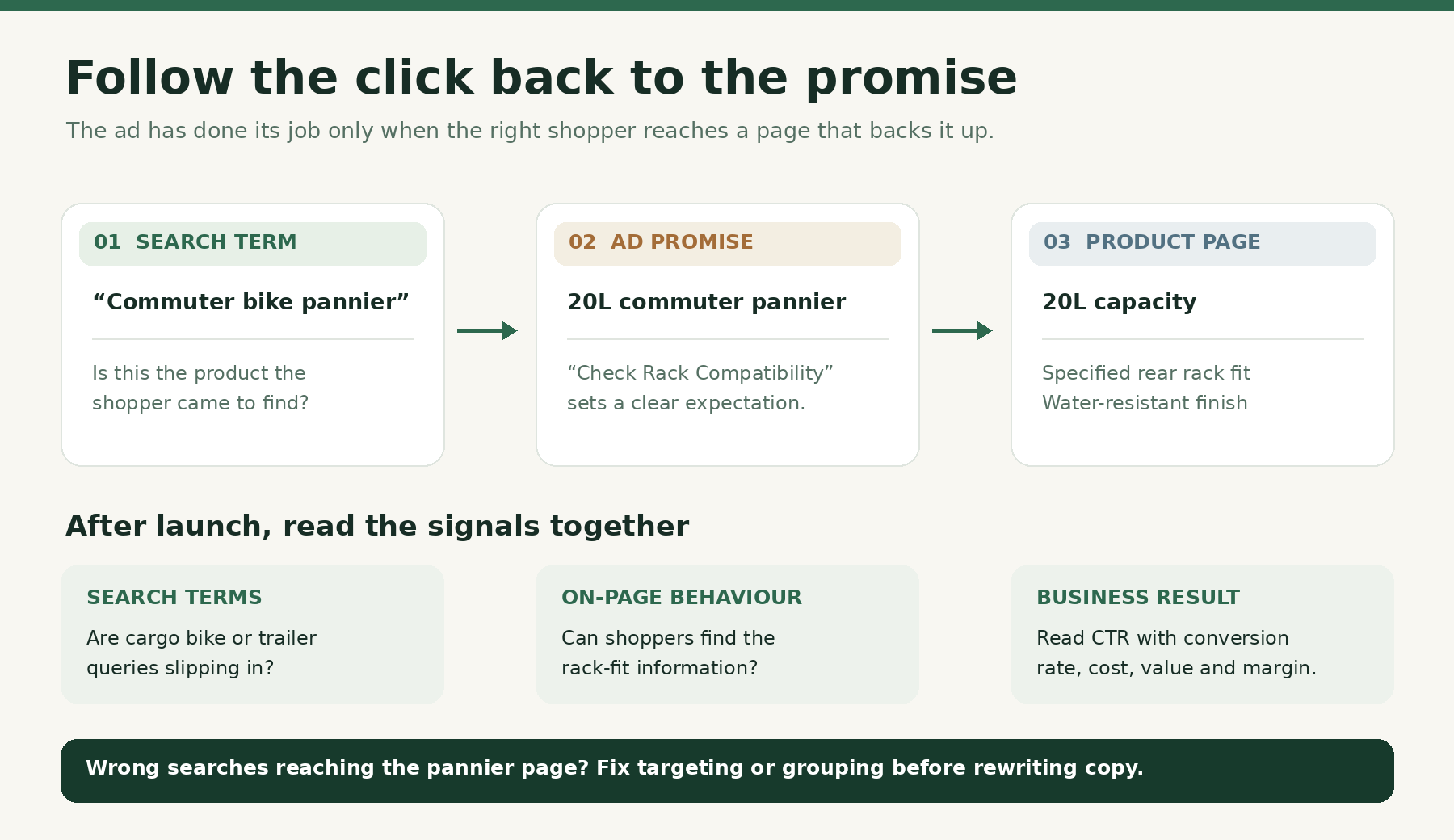
Read CTR alongside conversion rate, acquisition cost and conversion value, plus margin and returns if you have them. “Bike Gear for Every Ride” could easily win more clicks than a precise pannier headline while bringing in people who never wanted that bag. Keep a record of the brief, the AI tool, the date you generated the copy and what a human changed afterwards. If bids, budgets, offers or the search mix changed at the same time, account for that before giving the copy the credit. And where there’s enough traffic, run a proper experiment.
We started with a commuter who needed a bag for tomorrow’s ride. A good ad helps that person recognise the right product and gives them a reason to look closer, and then the page confirms what the ad said. AI can help you say it clearly. Whether anyone believes it depends on the search, the product and the page, and that part is still your job.
Get the AI brief and combination-check prompt by email
Want to run this process on your own products? Enter your email and we’ll send the full prompt. It covers grouping search intent, gathering verified facts, finding a distinctive angle and checking responsive ad combinations.
If your products are meaningfully different but your Google Ads make them sound interchangeable, have a look at Cue For Good’s paid search work or get in touch.
- About the Author
- Latest Posts

Kunal Mahajan is a Digital Advertising Specialist at CueForGood with 5 years of experience in the field. He loves spending time in the Google Ads cockpit, whether it’s creating ads, building campaign structures, testing new ideas, or figuring out strategies that work. For him, running ads is a lot like playing a game. Every campaign brings a new challenge, every optimization is a new move, and getting great results is what makes it all worth it.

Kunal Mahajan
Kunal Mahajan is a Digital Advertising Specialist at CueForGood with 5 years of experience in the field. He loves spending time in the Google Ads cockpit, whether it's creating ads, building campaign structures, testing new ideas, or figuring out strategies that work. For him, running ads is a lot like playing a game. Every campaign brings a new challenge, every optimization is a new move, and getting great results is what makes it all worth it.
MORE POSTS-
Google Ads copy with AI: fix the ad group first, then check the combinations
by Kunal MahajanBetter ads start with the right searches and the facts on your product page. Say you run an online cycling …
Continue reading “Google Ads copy with AI: fix the ad group first, then check the combinations”
-
Google Shopping for Ecommerce: A Simple Guide to Getting More Sales
by Yash Pal
Google Shopping has changed a lot over the years. The way Google Shopping campaigns work today is very different from …
Continue reading “Google Shopping for Ecommerce: A Simple Guide to Getting More Sales”
-
How to audit what AI is saying about your brand in 30 minutes
by Rajiv Singha
AI visitors convert at 4.4x the rate of traditional organic traffic. And AI search traffic is up 527% year on …
Continue reading “How to audit what AI is saying about your brand in 30 minutes”
-
Sustainable vs Green Marketing: Key Differences and When to Use Each
by Tapam Jaswal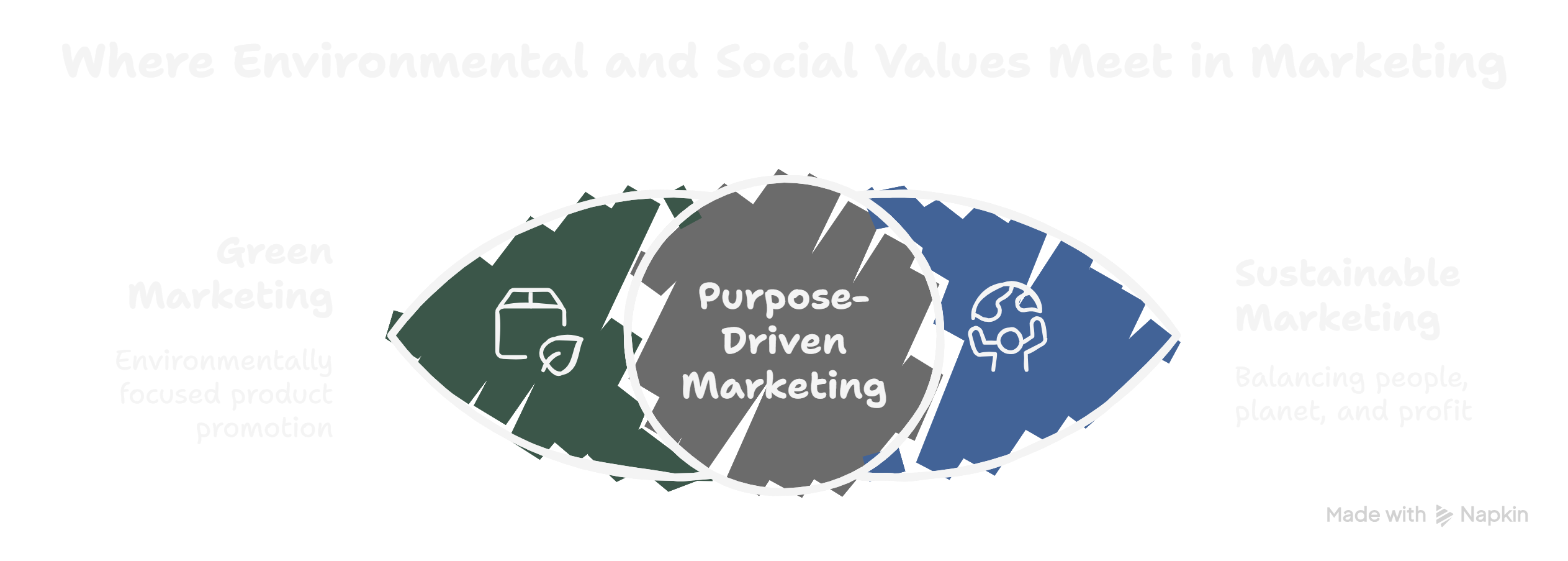
You’ll see the terms “green marketing” and “sustainable marketing” used interchangeably online. They are not the same. Here’s a side-by-side …
Continue reading “Sustainable vs Green Marketing: Key Differences and When to Use Each”
-
Why Feed-Only PMax Campaigns Are the Smartest Choice for Ecommerce stores
by Yash Pal
If you sell products online, you have probably heard about Google’s Performance Max (PMax) campaigns. They have been a hot …
Continue reading “Why Feed-Only PMax Campaigns Are the Smartest Choice for Ecommerce stores”
-
Email Marketing Without Fatiguing Conscious Consumers
by Charanjeev Singh
How to build trust, reduce inbox overload, and engage with intention Email marketing is a powerful tool. It lets …
Continue reading “Email Marketing Without Fatiguing Conscious Consumers”